
Disclaimer: This post includes affiliate links denoted with the asterisk.
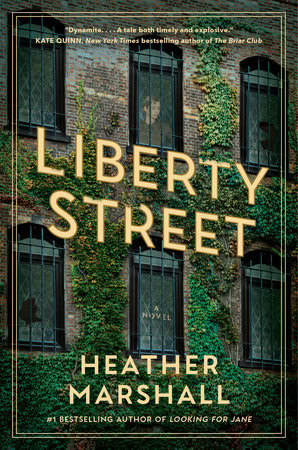
Liberty Street is Heather Marshall’s second novel, set in the same universe as her debut, Looking for Jane. In fact, there is a mention of the St. Agnes teens, although it really just is a mention, as the story isn’t about them.
This is a story about other women, bringing to light a very real and horrible piece of legislation from Canada’s history, the Female Refuges Act was a piece of legislation in Ontario that would allow people to quickly and easily imprison women.
Parents, husbands, and more were able to bring girls and women between the ages of 16 and 35 to the court and have them deemed “incorrigible,” as well as “unmanageable” and “idle and dissolute.” While some of them were prostitutes, there were others who were simply guilty of staying out past curfew or because they didn’t want to get married.
Liberty Street* does an excellent job of looking into this act, pulling out the important points for the story. And it’s enough to make you wonder if it was even real — and yes, scarily it was.
Liberty Street Brings Up the Real Horrors of the Past for Women
There are always stories of how women weren’t allowed to have their own bank accounts and credit cards. We know that for the longest time, women were reliant on the men in their lives, and at one point, they couldn’t even do the jobs that we do today. However, Liberty Street goes past that and into some of the many other horrors that women went through.
We get a look at just how easy it was for Emily to land herself in Mercer’s, a prison set up for the “incorrigible.” It is based on a real prison in Toronto that was eventually closed and pulled down. Yes, the acts that happened to the women, including a doctor purposely giving the women VD to test treatments, were based on true accounts.
Marshall doesn’t shy away from the horrors, but she also makes them part of the story to help see how Emily can fight against it all. There’s not a lot that she can do from the inside, but she’s gathering the evidence and telling her story. She is a pioneer of her time, making sure the word gets out about everything that is happening.
While they are deemed “incorrigible,” there are people outside who will want to know the truth. After all, we are all someone’s daughter or wife — and women especially can see themselves in these women.
The story is horrific, but it’s told so beautifully that I simply could not put it down. I was drawn into Emily’s fight for justice, trying to figure out how she could get the evidence that she needed, and whether she would learn to keep her head down just for the story. Of course, she doesn’t, and the story takes a twist at the end that I didn’t quite see coming — but I was relieved considering a list of names that came out that made me wonder if Emily would die while in the prison.
We only get the story from Emily’s point of view. This could usually be a problem, as we don’t get to see some of the drama that happens, but Marshall does an excellent job of narrating everything Emily is hearing, seeing, and smelling. When there’s a fire elsewhere in the building, we get the sense of the smoke closing in, and when there is a riot, we can experience it via Emily, who describes all the sounds that she can hear as she’s asking questions to herself.
A Story in Two Time Periods
I did find myself disappointed every time I was taken out of the story in 1961. There is another story running in 1996, as Detective Rachel Mackenzie is trying to figure out who the Jane Doe in an unmarked grave in a cemetery is. To be honest, the fact that this is an unmarked grave in the cemetery is interesting enough, and if the story remained focused on that part of the investigation, I wouldn’t have mind.
My issue was going back in time to the 1980s, when Rachel was growing up. There was a lot of time spent on Rachel’s relationship with her grandmother, Dora, and the lack of relationship with her selfish mother, Mary. I didn’t see how this could connect back to the 1961 story, and part of me does still wonder if it was needed.
What it did was flesh out Rachel’s character, though. It gave us the reason she fought so hard to get justice for others. The story opens with her focused on finding the body of a young missing teen, and then it is focused on getting answers about this Jane Doe case. While it’s good to get a backstory about her motivations, it did take me out of the story as a whole. Just not enough to put it down, because I really wanted to get on with the rest of the tale.
In the end, the two timelines converge. We get closure on the 1961 story, even if it’s not directly through Emily and her article that she intends to write. I don’t want to share who is involved in the closure, because that would spoil the story, but just know that enough characters from the past come up to help create the closure that is needed, while offering a little hope for the future.
Liberty Street is one of those novels that will sit with you for some time. It reminds me a lot of Yellow Wife* by Sadeqa Johnson, bringing up a part of history that isn’t always talked about or remembered. History isn’t meant to be liked; it’s something that we have to learn from, and Liberty Street by Heather Marshall will do just that.
Liberty Street* by Heather Marshall is now available to purchase on Amazon, Barnes & Nobel, and wherever you get your books.


